International Conference on Family Planning (ICFP 2025)
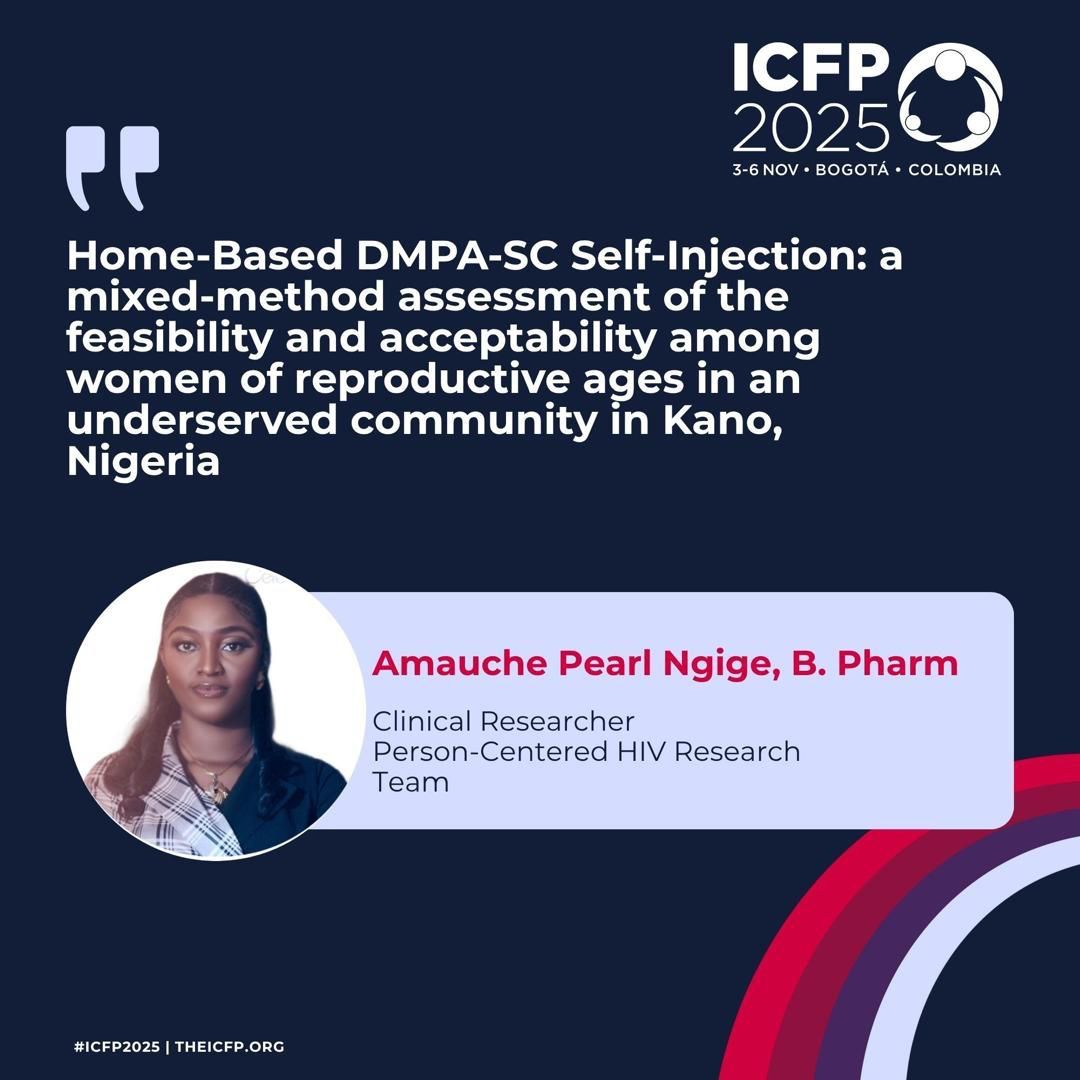
In 2025, the Person-Centered HIV Research Team (PeCHIVReT) joined researchers, advocates, health professionals, young people, and community leaders from around the world at the International Conference on Family Planning (ICFP) 2025 in Bogotá, Colombia.
Representing PeCHIVReT was our team member, Amauche Pearl Ngige, B.Pharm, who participated in the ICFP Youth Summit and represented the team through both oral and poster presentations. Her participation provided an opportunity not only to share our research beyond Nigeria, but also to listen, learn, and reflect on how evidence can better respond to the realities of the people and communities it is intended to serve.
The conference theme, “Equity through Action: Advancing Sexual and Reproductive Health and Rights for All,” closely reflected an approach that sits at the heart of our work: health research should not stop at generating evidence. It should help create conditions in which people can access information, make informed decisions, exercise agency, and receive services that respond to their actual needs.
Putting Young People at the Centre
The ICFP Youth Summit, themed “Voices, Evidence, Action: An Intergenerational Movement for All,” offered particularly important reflections on the role of young people in sexual and reproductive health and rights (SRHR).
One statement from the summit captured the gap that still exists in how many young people learn about SRHR:
“I was taught not to have sex before even knowing what sex is.”
Beyond the statement itself was a larger question of what happens when young people are given rules without the information, language, safety, and autonomy needed to understand their health and make informed decisions
Several lessons stood out to us.
Autonomy and agency matter
Young people should not simply be recipients of SRHR information. They should have a meaningful role in shaping the conversations, services, research, and policies that affect them.

This means moving beyond asking young people to participate after decisions have already been made. It means creating opportunities for them to influence what questions are asked, how research is conducted, and how findings are translated into practice.
Language can determine who gets included
The conference also highlighted the importance of communicating SRHR information in ways that people can understand and relate to. Discussions around pleasure, contraception, consent, and reproductive health cannot be truly inclusive when language itself becomes a barrier.
For communities across Africa, this raises an important opportunity: how can research and health communication better incorporate indigenous languages and culturally relevant approaches without compromising accuracy?
Equity must include disability justice
Another important lesson was that SRHR equity cannot be achieved without the meaningful inclusion of persons with disabilities.
Inclusion should extend beyond ensuring that people with disabilities can access services. Their experiences should inform the design of research, advocacy, health programmes, and policies from the beginning.
For PeCHIVReT, these conversations reinforced the importance of asking not only “Does an intervention work?”, but also “For whom does it work, under what circumstances, and who might still be left behind?”
Sharing Evidence from Nigeria
ICFP 2025 also provided a platform for PeCHIVReT to contribute evidence from Nigeria.
Amauche presented our research titled:
“Home-Based DMPA-SC Self-Injection: A Mixed-Method Assessment of the Feasibility and Acceptability Among Women of Reproductive Age in an Underserved Community in Kano, Nigeria.”

The study explored the feasibility and acceptability of home-based self-injection of DMPA-SC, a self-injectable contraceptive option, among women of reproductive age in an underserved community.
The findings pointed towards strong feasibility and increasing acceptability of home-based DMPA-SC self-injection, particularly among women who had previous contraceptive experience.
These findings are important because contraceptive access is not only about whether a method exists. It is also about whether people can obtain it, understand it, use it confidently, and make decisions about it on their own terms.
Self-injection has the potential to give women greater control over when and where they access contraception. However, expanding such approaches requires more than making a product available. It requires appropriate education, skills training, supportive services, and systems that enable women to make informed choices.
Through both the oral and poster presentations, PeCHIVReT was able to contribute to a broader global conversation while bringing evidence from an underserved Nigerian community into that conversation.
What We Are Taking Home
One of the most valuable outcomes of attending a global conference is the opportunity to return with better questions.
ICFP 2025 challenged us to think more deeply about what person-centred research should look like in practice.
We were reminded that equity is not achieved by creating the same solution for everyone. It requires understanding differences in people's circumstances and designing approaches that respond to those differences.
We also saw the importance of connecting research with lived experience. Statistics can tell us the size of a problem, but listening to communities helps us understand what that problem actually looks like in people's lives.
The conference further reinforced the value of youth participation, inclusive communication, community involvement, and intergenerational collaboration. These are not additional features of effective SRHR work. They are part of what makes the work meaningful and sustainable.
At PeCHIVReT, we believe that conference participation should not end when the conference does.
Our next step is to translate what we learned in Bogotá into our research, advocacy, communication, and community engagement.
We hope to apply these lessons by:
Strengthening youth involvement in the design, implementation, interpretation, and dissemination of our research.
Making research communication more accessible, including exploring culturally and linguistically appropriate ways of communicating SRHR evidence.
Embedding inclusion more deliberately by considering the experiences of populations who are often excluded from research and health programmes.
Connecting evidence with action, ensuring that research findings inform practical conversations around health education, service delivery, advocacy, and policy.
Expanding person-centred approaches across our work, asking whose needs are being addressed, whose voices are missing, and what barriers may prevent people from benefiting from an intervention.
Sharing knowledge within our team and wider networks, so that conference learning becomes collective capacity rather than individual experience.
Most importantly, ICFP 2025 reminded us that evidence is most powerful when it moves.
It moves from research questions to communities.
From communities to conversations.
From conversations to decisions.
And from decisions to action.
Our participation at ICFP 2025 was both a representation of the work PeCHIVReT is already doing and an opportunity to rethink what more can be done.
From research conducted in underserved communities in Nigeria to conversations taking place on a global stage in Bogotá, the message was clear: advancing sexual and reproductive health and rights requires more than good intentions. It requires evidence, participation, inclusion, and sustained action.
We are grateful to have been part of a space that brought together diverse perspectives around a shared goal of advancing SRHR for all.
As we continue our work, we carry the lessons from Bogotá with us, not simply as memories from a conference, but as ideas to test, adapt, share, and put into practice.
Because for us, the value of research is not only in what we discover. It is in what we do with what we discover.